
The TELSEC Chronicle
Deep Dive
Exploring the critical issues facing today's infrastructure operators.
Lead/Lag Controllers in HVAC Systems: Enhancing Efficiency and Reliability
Lead/lag controllers play an important role in improving the performance, reliability, and efficiency of HVAC systems that use multiple heating or cooling units. By coordinating when each HVAC unit operates, a lead/lag controller can balance equipment runtime, provide additional capacity when needed, and help maintain environmental conditions without unnecessarily operating every unit at the same time.
This type of control is particularly valuable in critical facilities such as telecommunications sites, broadband facilities, utility locations, data centers, equipment shelters, and other unmanned or remote facilities where maintaining proper temperature is essential to protecting equipment and keeping operations online.
What Is a Lead/Lag HVAC Controller?
A lead/lag HVAC controller manages two or more HVAC units serving the same space. It determines which unit operates as the primary, or lead, unit and when an additional, or lag, unit should operate.
Rather than allowing one HVAC unit to accumulate significantly more runtime than another, the controller can periodically rotate the lead assignment. This helps balance equipment usage and wear.
When cooling or heating demand exceeds the capacity of the lead unit, the controller can bring the lag unit online to provide additional capacity.
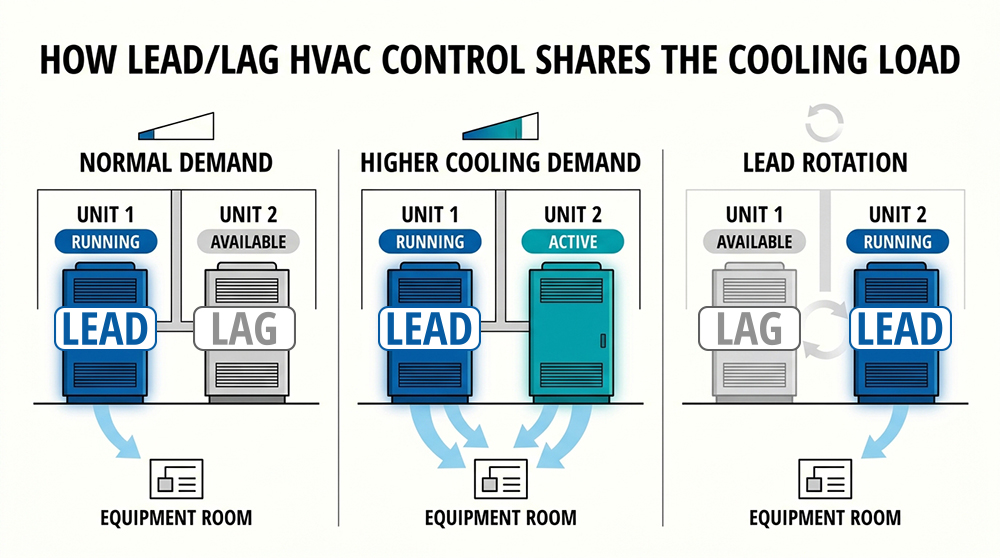
For example, in a facility with two air conditioning units:
- Unit 1 may initially operate as the lead unit.
- Unit 2 remains available as the lag unit.
- If Unit 1 cannot maintain the desired temperature, Unit 2 can be activated to provide additional cooling.
- At a predetermined interval, the controller can rotate the lead assignment, so Unit 2 becomes the primary unit.
This coordinated operation provides a simple but effective way to improve HVAC redundancy, balance runtime, and maintain more consistent facility conditions.
Important: Lead/lag control is appropriate when the HVAC units are conditioning the same space or environmental zone.
Click to enlarge image
How Does Lead/Lag HVAC Control Work?
A lead/lag control strategy typically combines equipment rotation with staged operation.
During normal conditions, the lead HVAC unit handles the primary heating or cooling load. The lag unit remains off until additional capacity is required.
If the temperature continues to move away from the desired setpoint, the controller can activate the lag unit. Both units can then operate until conditions return to an acceptable range.
The controller can also periodically alternate which HVAC unit is designated as lead. Instead of one unit operating most of the time while the second accumulates relatively few hours, both units share the workload over time.
More advanced HVAC controllers can incorporate additional information such as multiple temperature sensors, humidity, equipment alarms, outside air conditions, and communications with remote monitoring systems.
Lead/Lag vs. Lead/Standby HVAC Control
Although the terms are sometimes used interchangeably, lead/lag and lead/standby can describe different operating strategies.
In a lead/lag configuration, the second HVAC unit is available to provide additional heating or cooling capacity when the lead unit alone cannot satisfy demand. Both units may operate simultaneously during higher load conditions.
In a lead/standby configuration, the secondary unit primarily serves as backup equipment. If the lead HVAC unit fails or becomes unavailable, the standby unit can take over.
The appropriate strategy depends on the facility, HVAC capacity, required redundancy, operating conditions, and the consequences of losing environmental control.
For critical facilities, the ability to support redundant HVAC equipment can be especially important because an HVAC failure may affect much more than occupant comfort.
Why Rotate HVAC Units?
Without automatic rotation, one HVAC unit can accumulate substantially more operating hours than another. Over time, that imbalance can lead to uneven wear, maintenance requirements, and equipment life.
Lead/lag rotation distributes runtime more evenly between available HVAC units.
This can provide several benefits:
Balanced equipment runtime: Prevents one HVAC unit from consistently carrying most of the load.
Reduced wear: Sharing operating hours can reduce excessive wear on the primary unit.
Improved redundancy: Multiple HVAC units remain actively incorporated into the control strategy rather than leaving backup equipment unused for extended periods.
Simplified operation: Automatic rotation eliminates the need for personnel to manually change the lead unit on a regular schedule.
Balanced runtime does not eliminate HVAC maintenance, but it can help operators use redundant equipment more effectively.
Benefits of Lead/Lag Controllers in HVAC Systems
Improved Energy Efficiency
A properly configured controller operates HVAC equipment according to actual demand. Under normal conditions, a single unit may be sufficient to maintain the required temperature, avoiding unnecessary simultaneous operation of multiple HVAC units.
Additional units can be staged when the environmental load requires them.
Extended Equipment Life
By periodically rotating the lead HVAC unit, operating hours can be distributed more evenly across the available equipment. This can help reduce excessive wear on a single unit and support more balanced maintenance schedules.
Increased System Reliability
Lead/lag control provides a coordinated method of managing redundant HVAC equipment. If environmental conditions require additional capacity, another unit can be activated.
Depending on the controller and HVAC configuration, the secondary unit may also be available when the primary equipment experiences a failure.
More Consistent Environmental Control
Critical facilities can experience rapidly changing thermal loads. Lead/lag control allows additional HVAC capacity to be staged as conditions change rather than relying entirely on a single HVAC unit.
Reduced Need for Manual Intervention
Automatic equipment rotation and staging reduce the need for personnel to visit a facility simply to change which HVAC unit is operating as lead.
For organizations managing many remote facilities, eliminating even routine site visits can become an important operational advantage.
Where Are Lead/Lag HVAC Controllers Used?
Lead/lag HVAC control can be used anywhere multiple HVAC units condition a common space, but it is particularly useful in facilities where environmental control and equipment redundancy are operational requirements.
Common applications include:
- Telecommunications shelters and central offices
- Broadband headends and hubs
- Utility and power substations
- Data centers and edge computing facilities
- Equipment rooms
- Remote cabinets and shelters
- Network and switching facilities
- Other unattended critical infrastructure sites
These environments often contain electronic and communications equipment that generates substantial heat and must operate continuously.
In these applications, HVAC control isn't simply about keeping a building comfortable. It is part of protecting the infrastructure inside the facility.
Why Lead/Lag Control Matters in Critical Facilities
A conventional commercial building can often tolerate a temporary HVAC problem without immediately affecting the building's primary function.
A critical equipment facility can be very different.
Telecommunications, broadband, utility, and data facilities may contain continuously operating electronic equipment that generates heat around the clock. If cooling capacity is reduced or lost, facility temperature can rise and potentially threaten the equipment supporting critical services.
Many of these facilities are also unmanned.
For this reason, HVAC control for critical infrastructure often needs to accomplish several objectives simultaneously:
- Maintain the required environmental conditions
- Coordinate redundant HVAC equipment
- Detect abnormal conditions
- Provide backup cooling strategies
- Balance equipment runtime
- Communicate alarms and operating information to remote personnel
A lead/lag controller can therefore become part of a broader facility monitoring and control strategy rather than functioning only as a temperature controller.
Combining Lead/Lag Control with Remote HVAC Monitoring
Traditional lead/lag controllers may perform their control functions locally but provide little information about what is happening at a remote facility.
Adding communications changes that equation.
A network connected HVAC controller can allow facility operators or network management systems to access information such as temperatures, operating status, alarms, equipment conditions, and controller settings without traveling to the site.
Remote visibility can help answer important operational questions:
- Is the lead HVAC unit running?
- Has the lag unit been activated?
- Is facility temperature increasing even though cooling has been commanded?
- Has an HVAC alarm occurred?
- Are both units accumulating comparable runtime?
For organizations responsible for dozens, hundreds, or thousands of distributed facilities, this information can help personnel identify problems earlier and determine which sites actually require attention.
Lead/Lag Control and HVAC Economizers
Lead/lag control addresses how multiple HVAC units operate, but mechanical cooling is only one way to maintain facility temperature.
In suitable climates and operating conditions, an HVAC economizer can use cooler outside air to reduce the amount of mechanical cooling required.
Combining intelligent lead/lag control with economizer operation can provide another opportunity to reduce HVAC energy consumption in equipment facilities with year round cooling requirements.
Rather than relying exclusively on compressors whenever cooling is required, an intelligent controller can determine when outside air conditions are appropriate for free cooling and coordinate HVAC operation accordingly.
This can be particularly valuable in telecommunications and other critical facilities where electronic equipment generates heat even when outdoor temperatures are relatively low.
Choosing a Lead/Lag HVAC Controller
The appropriate controller depends on both the HVAC equipment and the operational requirements of the facility.
Important considerations can include:
Number and type of HVAC units: Determine whether the controller supports the number of units, stages, heat pumps, wall mounted systems, rooftop units, or split systems used at the facility.
Lead/lag and lead/standby capability: Consider how redundant equipment should operate during normal demand, high load conditions, and equipment failures.
Temperature sensing: Multiple zone sensors can provide a more representative picture of conditions within an equipment facility than a single thermostat.
Remote communications: Ethernet, Modbus, SNMP, or other communications can be important when HVAC operation needs to be integrated into a broader facility or network management system.
Alarm capabilities: Operators should consider what conditions need to generate alarms and how those alarms will reach personnel.
Economizer support: Facilities with significant year round cooling requirements may benefit from intelligent outside air economizer control.
Standalone reliability: Critical control functions should continue operating locally even if communications with a remote monitoring system are interrupted.
The goal should be to select a controller that matches both the HVAC equipment and the operational importance of the facility it protects.
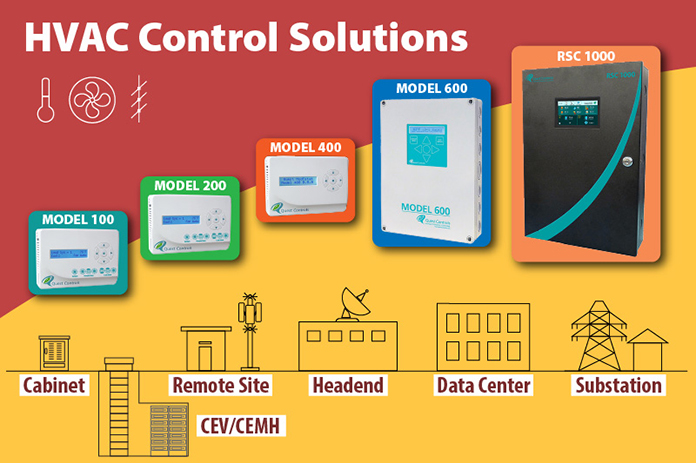
Quest offers a range of intelligent HVAC controllers for remote facilities and critical infrastructure.
Quest Controls Lead/Lag HVAC Controllers
Quest Controls develops HVAC monitoring and control solutions specifically for remote sites and critical infrastructure.
Quest's HVAC controller family ranges from straightforward replacements for traditional lead/lag controls to network connected controllers capable of integrating HVAC operation with broader facility monitoring systems.
The Model 600 Lead/Lag Controller, for example, is designed for critical facilities using two HVAC units and supports lead/lag or lead/standby configurations. It provides Ethernet connectivity with a built-in web server and supports Modbus TCP and SNMP, allowing HVAC information and alarms to be integrated with remote management systems.
The Model 600 also supports Quest's patented economizer control technology, providing facilities with an opportunity to take advantage of outside air cooling when environmental conditions permit.
Other Quest HVAC solutions provide options for different facility sizes, HVAC configurations, communications requirements, and levels of monitoring and control.
Frequently Asked Questions About Lead/Lag HVAC Control
What does lead/lag mean in HVAC?
Lead/lag describes a control strategy for multiple HVAC units serving the same space. One unit operates as the primary or lead unit, while another unit can be staged as the lag unit when additional heating or cooling capacity is required. The lead assignment can also be rotated to balance equipment runtime.
Can both lead and lag HVAC units run at the same time?
Yes. In a lead/lag configuration, the lag unit can be activated when the lead unit cannot satisfy the heating or cooling demand by itself. Both units may operate until the desired environmental conditions are restored.
What is the difference between a lag unit and a standby unit?
A lag unit is generally staged to provide additional capacity when demand increases. A standby unit primarily provides redundancy and can take over if the primary unit is unavailable. Some HVAC controllers support both operating strategies.
Can lead/lag HVAC systems be monitored remotely?
Yes. When the controller provides network communications, HVAC temperatures, operating conditions, alarms, and other information can be made available to remote monitoring or management systems. Depending on the controller, authorized users may also be able to adjust supported settings remotely.
Are lead/lag controllers useful for remote facilities?
They can be especially valuable in remote and unmanned facilities. Automatic equipment rotation, redundant cooling control, alarm capabilities, and remote communications can reduce the need for routine site visits while providing operators with better visibility into HVAC performance.
Intelligent HVAC Control for Critical Infrastructure
A lead/lag controller does more than alternate between HVAC units. Properly implemented, lead/lag control helps balance equipment runtime, stage cooling or heating capacity according to demand, improve redundancy, and maintain stable environmental conditions.
For critical infrastructure, those capabilities can become part of a larger strategy for protecting equipment, reducing unnecessary energy use, improving remote visibility, and keeping facilities operating reliably.
Quest Controls offers a range of HVAC controllers designed specifically for telecommunications, broadband, utility, data center, and other critical facility applications.